
STEP in Physical Education: Change the Activity, Not the Learning Goal
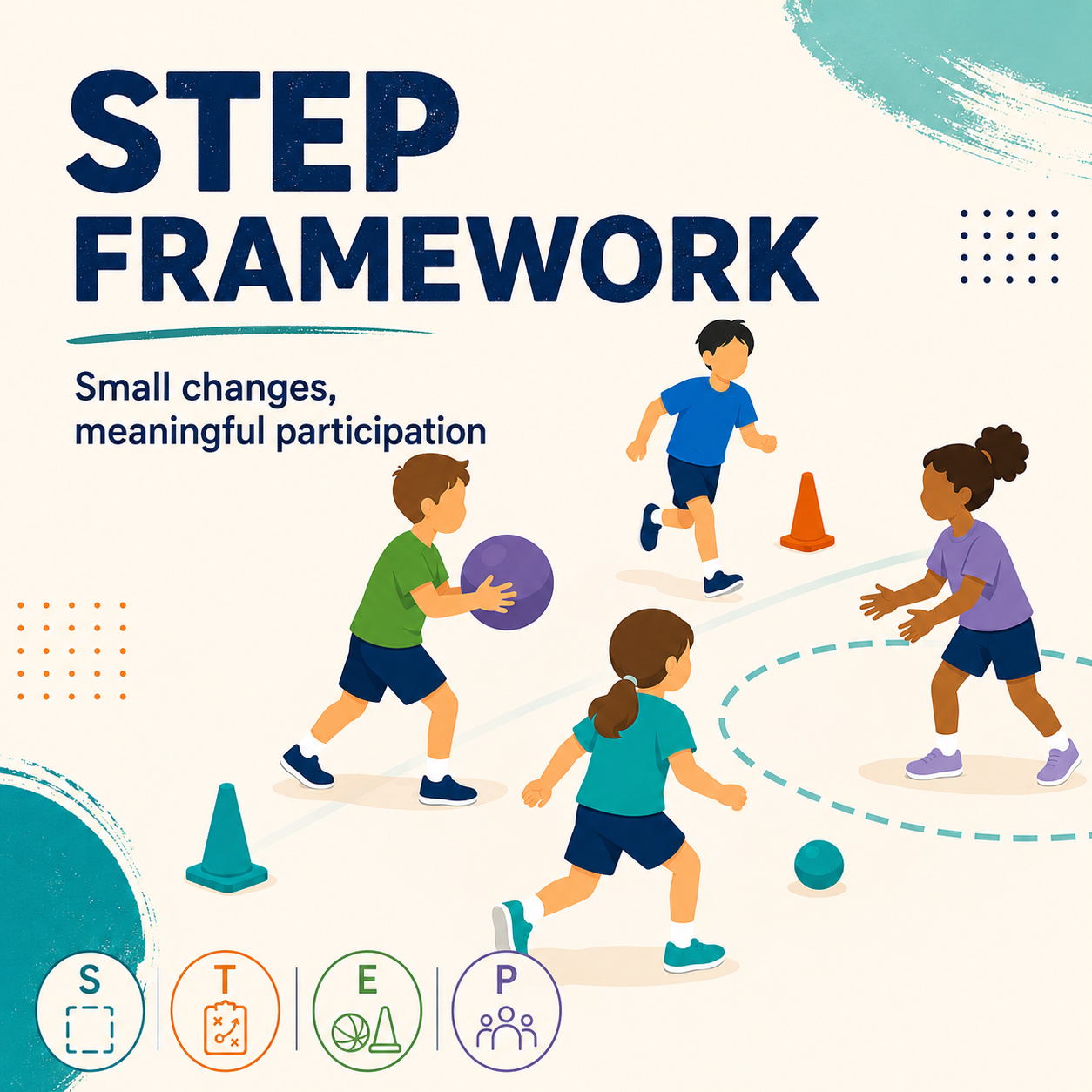
The game has been running for several minutes. Sofia stays close to the edge of the playing area. She understands the rules, but usually positions herself where the ball is unlikely to reach her. Amir watches his classmates first and then tries to copy what they are doing. He can perform the skill, but the long and fast verbal explanation did not help him understand exactly what was expected.
Nefeli has low vision. She finds it difficult to see the pale boundary lines and follow the movement of the ball.
Markos receives the ball constantly and completes the activity without needing to make much effort.
On the surface, all four children appear to be taking part. In reality, each of them is experiencing a different lesson. Sofia is afraid of being exposed in front of others. Amir does not have full access to the instructions. Nefeli cannot clearly perceive the space and equipment. For Markos, the activity is no longer genuinely challenging.
The scene is fictional, but it brings together situations that frequently arise in Physical Education.
With a large class, one shared space, and limited equipment, it is not realistic to design a separate lesson for every child. Often, however, one small and purposeful change is enough to help a child take part meaningfully.
The framework that helps us identify that change is called STEP.
What is STEP?
STEP is an adaptation framework used in inclusive Physical Education and school sport. It organises the changes we can make into four main areas. It is explained in the Activity Alliance Inclusive PE Activity Cards, while the Youth Sport Trust attributes the framework to its work from 2002.
STEP stands for:
- Space
- Task
- Equipment
- People
Almost every game or activity includes these four elements. STEP does not provide a ready-made formula. Instead, it helps us see where we can intervene when an activity is not working equally well for every child.
By changing the space, task, equipment, or the way participants are organised, we can provide additional support or increase the level of challenge.
In most adaptations, the central learning goal remains the same. In a parallel or specific activity, a different but closely related goal may be used, provided that it remains equally meaningful for the child’s learning.
STEP is therefore not only a way to make an activity easier. It can also make it more demanding for a learner who has already mastered the basic skill.
Before deciding what to change, we need to answer two questions:
What is actually preventing the child from participating?
What learning do we want to preserve?
Start with the barrier, not a ready-made solution
When a child remains on the edge of an activity, it is easy to assume that the task is simply too difficult.
That may be true. The child may also be afraid of making a mistake, may not have understood the instructions, may be overwhelmed by noise or visual information, may be unable to use the available equipment, or may not feel safe within the group.
In other cases, the opposite is happening: the activity is so easy that the child no longer has a reason to make an effort.
According to UNESCO’s approach to inclusion in education, inclusion is not only about differences in learners’ abilities. It involves identifying and removing barriers within the curriculum, pedagogy, and teaching that restrict access, participation, and learning.
Teacher observation is essential, but it is not always enough. A short and discreet conversation may reveal something that is not immediately visible:
- “What is making this difficult for you?”
- “What change do you think would help you try?”
The child’s answer does not replace professional judgement. It may, however, provide information that observation alone cannot reveal.
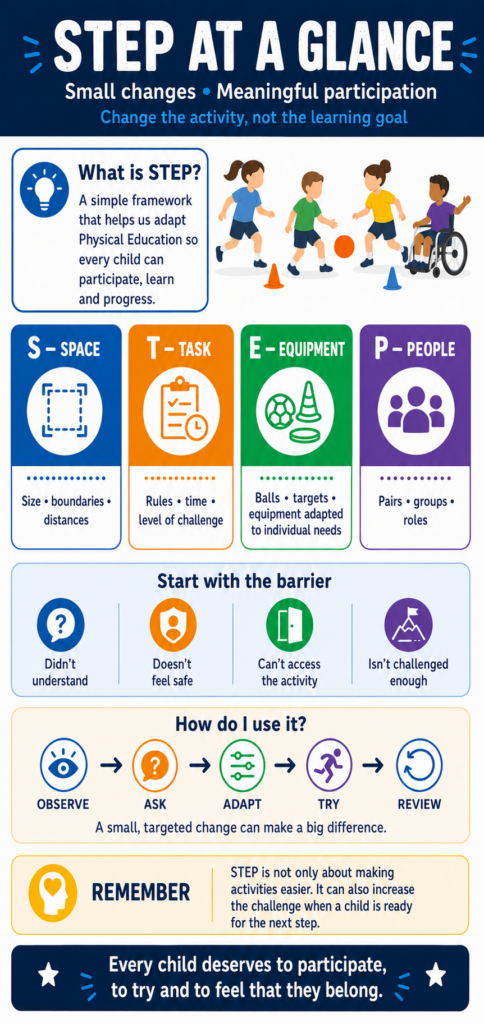
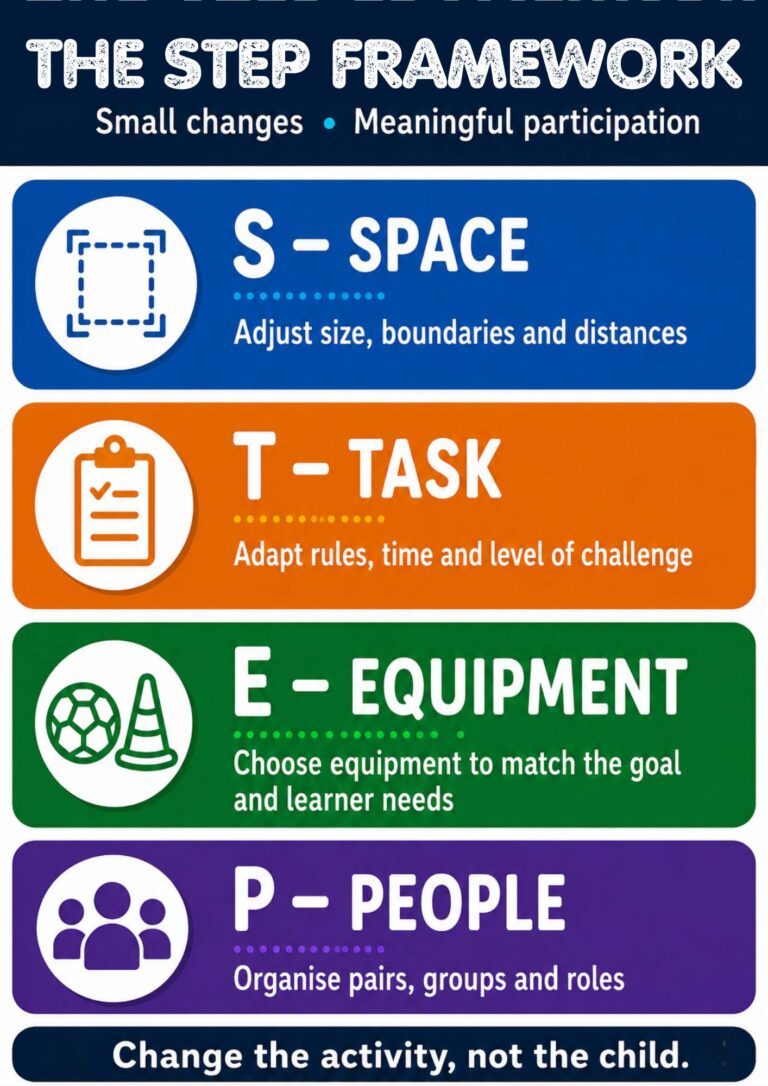
The four elements of STEP
📍 S — Space
Space refers to where the activity takes place and how that area is organised.
We can change:
- the size and shape of the playing area,
- its boundaries and surface,
- the distance between players,
- the position and height of targets,
- movement or receiving zones,
- the space and time available for a response,
- the safety distance between players or obstacles.
A larger area can provide more time to react, control the ball, and make a decision. A smaller area may require quicker movement, greater awareness, and more complex decision-making.
The space can also be divided into zones. In a passing game, for example, a receiving zone could require defenders to remain at a distance for two seconds. This gives the learner slightly more time to receive and control the ball without removing them from the main game.
A throwing activity could offer several distance lines. A closer line increases the chance of success, while a longer distance provides an additional challenge.
The most appropriate adaptation does not always mean creating more space. It depends on the barrier and on what the learner is expected to learn.
🎯 T — Task
Task refers to what the children are being asked to do.
It includes:
- the movement skill,
- the rules,
- pace and duration,
- the sequence of actions,
- the number of repetitions,
- how the activity begins and ends,
- the decisions that need to be made,
- the criteria for success.
We can break a complex skill into smaller steps, introduce one rule at a time, or temporarily simplify one part of the activity.
In a catching game, we might allow the ball to bounce once before it is caught. In a passing game, we might temporarily reduce defensive pressure or require the ball to pass through several different players before a point can be scored.
The task can also be made more demanding:
- by reducing decision-making time,
- by providing more options,
- by adding a tactical condition,
- by using the non-dominant hand or foot,
- by setting a more demanding accuracy target,
- by combining two skills.
An adaptation does not need to weaken the learning goal. It can create a more appropriate route through which the child can reach it.
🏀 E — Equipment
Equipment refers to the objects and materials used in the activity.
We can change:
- size and weight,
- shape,
- colour and contrast,
- texture and firmness,
- speed,
- how the equipment can be heard or perceived,
- the height at which it is placed.
A larger, lighter, or softer ball may travel more slowly and be easier to control. A brightly coloured ball may stand out more clearly against the background, while a ball with a sound element may help a learner with low vision follow its movement.
A target may be made larger or lower. Equipment can also be placed at a different height so that it is accessible to a learner who finds bending difficult or uses a wheelchair.
To increase the challenge, we might use:
- a smaller target,
- a smaller or faster ball,
- equipment that demands greater accuracy,
- an object that requires more control.
Equipment should be selected in response to the actual barrier, rather than simply to make the activity easier.
👥 P — People
People refers to the children and adults involved in the activity and to the way they cooperate or compete.
We can change:
- group size,
- pairings,
- the number of attackers and defenders,
- roles,
- the way children work together,
- how often partners or teammates change,
- the balance between support and competition.
Smaller groups usually provide more opportunities to touch the ball, move, and make decisions.
A neutral player who always supports the team in possession can reduce pressure and help that team keep the ball.
Roles can also be changed so that children participate in different ways. Those roles, however, must have genuine learning value. A child should not be permanently assigned as a helper, referee, or scorekeeper simply to appear occupied.
Pairs and groups should remain flexible. Temporary ability grouping may support a particular learning objective, but it should not create permanent categories of “strong” and “weak” learners.
🧩 How should participation be organised across the whole class?
So far, we have considered what can be changed within an activity. One practical question remains: should every child always do exactly the same thing, or can learners work in different ways?
The Activity Inclusion Model — AIM helps answer this question. Activity Alliance presents AIM as an evolution of the Black and Stevenson Inclusion Spectrum and describes four ways of organising participation.
Open activity: Everyone takes part together with little or no modification.
Modified activity: Everyone participates in the same main activity, which is adapted using STEP.
Parallel activity: Learners work in related versions of the same activity, using different equipment, targets, or levels of challenge.
Specific activity: A disabled learner temporarily works on an activity or form of sport that responds to a particular need, helping them develop skills that can support more active participation in the future.
None of these approaches is automatically more inclusive than the others. The most appropriate choice depends on the learning goal and on what the learner genuinely needs.
Having everyone in the same game does not mean that everyone is learning. Equally, a temporary alternative activity is not automatically a form of exclusion. It may be the best choice when it has clear learning value, remains connected to the main activity, and does not repeatedly isolate the same learner.
⚠️ Disability sports
Sports such as goalball, boccia, and sitting volleyball should be taught as authentic sports with their own rules, skills, and history.
Disability simulation should not be used as a superficial “empathy exercise.”
🌱 When choices are available from the start
Adaptations are usually less stigmatising when they are not introduced afterwards for one particular child, but are available from the beginning as options for everyone.
This is also one of the central ideas of Universal Design for Learning — UDL. The CAST UDL Guidelines 3.0 are organised around multiple means of engagement, representation, and action and expression. They also emphasise choice, autonomy, appropriate challenge, belonging, and progress monitoring.
In Physical Education, this might include:
demonstrating an activity alongside verbal instructions,
offering more than one appropriate distance,
providing equipment with different handling or visibility demands.
When these options are available to the whole class, the adaptation does not appear to be a special exception for “the child who cannot do it.”
We can also use colours, numbers, or neutral names instead of labels such as “easy” and “hard.”
Choice does not mean removing every demand. It means giving every child access to a challenge that is meaningful and worth the effort.
Four children, four different barriers
The same visible outcome—a child who is not participating meaningfully—can have completely different causes.
- Sofia — fear of exposure: A smaller group, a receiving zone, or a temporary reduction in defensive pressure may give her more time and a greater sense of security without removing her from the main game.
- Amir — access to instructions: A brief demonstration, a simple visual sequence, and one rule introduced at a time may help him understand the activity without reducing the demands of the lesson.
- Nefeli — visual access: High-contrast boundaries, a brightly coloured ball or a ball with a sound element, and a clear description of the space can make the activity easier to perceive and access.
- Markos — insufficient challenge: Less decision-making time, a smaller target zone, or an additional tactical condition can help him continue to progress.
The right adaptation is not selected mechanically from a list. It emerges from the relationship between the learner, the activity, and the environment.
🔎 How do we know whether the adaptation worked?
An adaptation is not successful simply because the learner moved more or touched the ball more often.
We need to consider whether access improved, whether learning took place, whether the learner became more autonomous, and whether they genuinely felt part of the group.
Five areas can guide our evaluation:
Access and opportunity: Did the learner have more meaningful attempts, touches, or turns?
Learning: Did they improve the skill, understanding, or tactical decision that formed the learning goal?
Autonomy: Did they act with greater initiative and with an appropriate level of support?
Appropriate challenge: Was success possible without becoming automatic?
Belonging and learner voice: Did the learner feel safer and genuinely part of the group? What does the learner say about the change?
A complex recording system is not necessary. A short, specific note may be enough:
During the first five minutes, Sofia touched the ball twice. During the next five minutes, after the rule was changed, she touched it six times. She entered the receiving zone on her own initiative and said that the reduced defensive pressure helped her. She still avoided receiving the ball when the pressure became intense.
Temporary support or an access adjustment?
A temporary instructional support helps the learner gradually develop greater autonomy.
It might be a verbal reminder, a step-by-step demonstration, or additional time during initial practice. When the learner can perform consistently and with greater autonomy, the support can gradually be reduced.
An access adjustment, by contrast, allows the learner to perceive, approach, handle, or communicate within the activity.
Examples include high-contrast lines, an audible ball, an accessible route, adapted equipment, or a necessary communication system.
Success does not necessarily mean that the adjustment should be removed. It may mean that the learner is succeeding precisely because access has been secured.
The UDL Guidelines distinguish access to accessible tools and assistive technologies from graduated support for practice and performance.
After trying an adaptation, the teacher may:
- maintain an effective access adjustment,
- gradually reduce a temporary prompt,
- replace a change that did not help,
- increase the challenge when the learner is ready.
The practical cycle is simple:
Observe → Ask → Adapt → Try → Review
Progress does not always mean returning to the unadapted version. It means more learning, greater autonomy, and a stronger sense of belonging.
✅ A quick check before changing the activity
- What is the learning goal?
- What is the real barrier, and what is the learner telling me?
- Which element of STEP could I change?
- How will I know that access and learning have improved?
- Is this temporary support, or an access adjustment that needs to remain?
Final Thoughts
By the end of the lesson, none of the four children has been “fixed.” What has changed is the way each child can enter and experience the game.
Sofia feels less exposed. Amir understands what he is expected to do. Nefeli can see the space and follow the ball. Markos once again has a reason to make an effort.
The teacher did not try to correct the children. Instead, the teacher noticed what was getting in their way and changed the relationship between the learner, the activity, and the environment.
This is the real value of STEP:
We change the conditions for participation so that every child can learn, make an effort, and feel that they belong.
Join Our P.E. Community
Become part of a growing network of teachers who believe that movement is a powerful tool for learning. By joining our community, you’ll receive updates on new blog posts, free resources, and exclusive content — all designed to make your teaching more fun, inclusive, and effective.

Our Newsletter
Want fresh ideas, posters, games, and free P.E. resources delivered to your inbox?
Subscribe to our newsletter and be the first to know about new posts, exclusive content, and creative teaching ideas!
Because physical education should feel like play!