Circulation Mini-Volleyball: A Playful Pathway for Teaching Volleyball to Children
Volleyball is a wonderful team sport for children. It develops cooperation, communication, spatial awareness, quick reactions, and respect for teammates. However, anyone who has tried to teach volleyball to younger children knows the main challenge: the full game is technically demanding.
The ball drops quickly. Touches are often limited. Some children wait for their turn, while others dominate the play. And very often, the rally stops before the game has really begun.
This is where Circulation Mini-Volleyball (CMV) offers a very interesting solution. It is a modified form of mini-volleyball designed to help children learn through play. Instead of teaching isolated technical skills first and playing later, CMV allows children to play from the beginning — with simple rules, small teams, constant movement, and gradual progression.
CMV is presented in the FIVB material “Circulation- and mini-volleyball: Rules level 1–6”, which describes six progressive levels for children. The model begins with simple actions such as throwing, catching, and moving, and gradually leads children toward more structured mini-volleyball, including forearm passing, setting, serving, and attacking actions.
Why do we need modified volleyball games for children?
In the early stages of learning, the goal is not for the game to look like adult volleyball. The goal is for children to participate, understand what is happening, and feel that they can succeed.
When children are placed directly into a game format that is too difficult for their level, three things often happen: the ball drops immediately, the more skilled children take more control, and the less experienced children become passive. Instead of becoming a learning opportunity, the game can become a source of stress or frustration.
Modified games change this experience. They reduce the playing area, lower the number of players, simplify the rules, and create more opportunities for each child to touch the ball. FIVB’s mini-volleyball material presents smaller game formats as appropriate for school settings and for introducing young players to volleyball in a more accessible way.
This approach also connects well with game-based teaching models such as Teaching Games for Understanding (TGfU). TGfU places emphasis on play, where tactical and strategic problems are explored through modified game environments.
In simple words: children do not learn volleyball only by repeating a technique. They learn when that technique has meaning inside the game.
What makes Circulation Mini-Volleyball different?
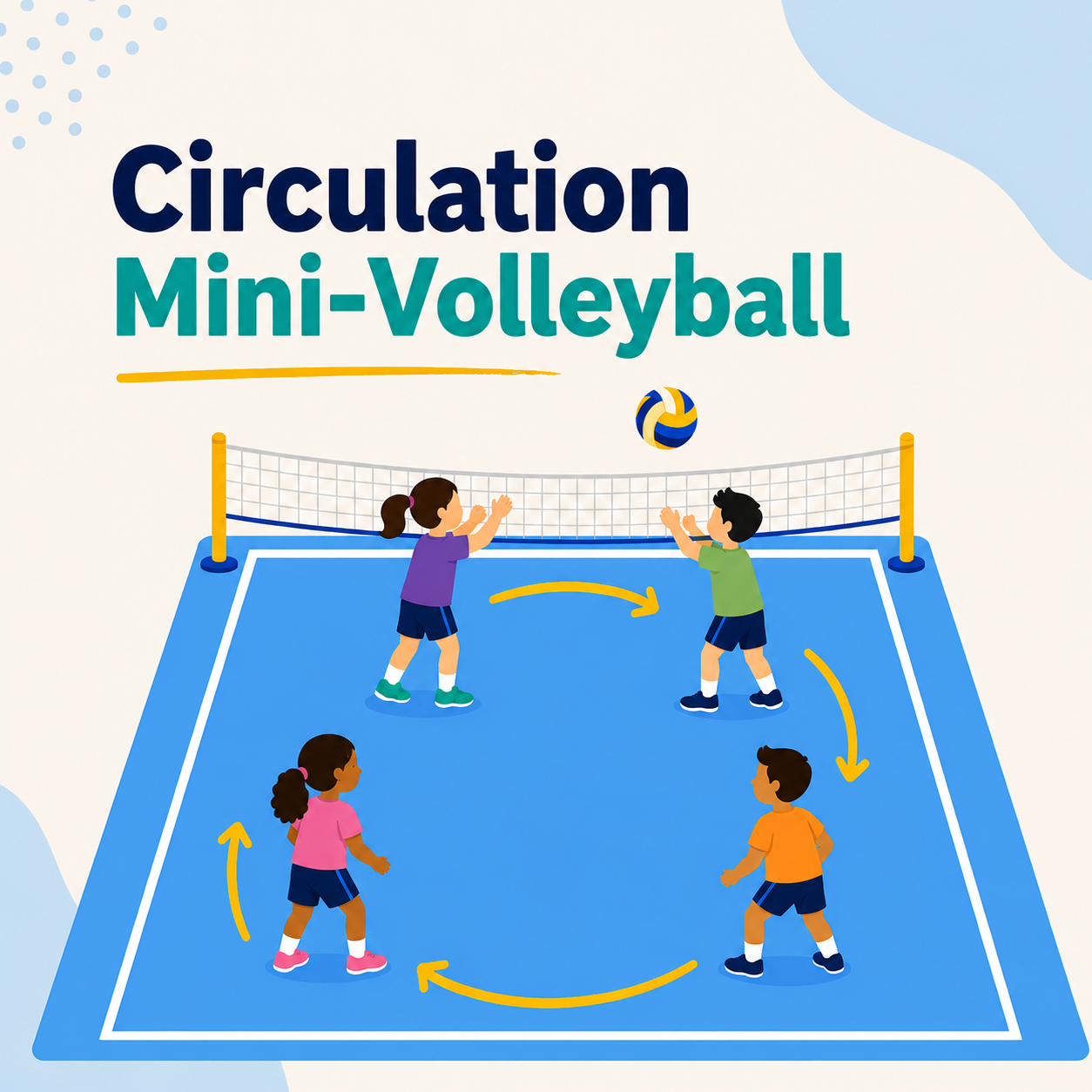
The most distinctive feature of CMV is circulation. In the early levels, every time a team sends the ball over the net, all players rotate clockwise and move to a new position. This rule appears from Level 1 of the FIVB CMV material: after the ball is thrown over the net, the whole team rotates one position clockwise.
This may seem simple, but it has strong educational value. No child stays fixed in one position. Everyone moves. Everyone has to relocate in space. Everyone needs to pay attention to the ball, their teammates, and the court.
This is perhaps one of the greatest strengths of CMV: before asking a child to perform a “correct” forearm pass, the game helps them move under the ball, read its path, time their movement, and cooperate with their team. Technique does not appear suddenly as a difficult demand. It is built on experiences of movement, space, and play.
In this way, volleyball becomes more accessible. The child does not begin with the pressure of perfect ball contact, but with a simple task: move, catch, throw, rotate, and rejoin the play.
The six-level structure
CMV is organized into six levels, roughly corresponding to ages 6–12. However, age should not be treated as a strict rule. It is better understood as a guide. If a group has little previous volleyball experience, it may be appropriate to begin at an easier level, even if the children are older.
Across all levels, the basic format is 4 vs 4. This is important because it keeps the game functional. With fewer players, children have more responsibility, more ball contacts, and a clearer understanding of space. The FIVB CMV material presents 4 vs 4 as the standard playing format across the levels.
In Levels 1–3, the game has a more playful elimination-and-return structure. The team tries to “empty” the opponent’s court, while players who temporarily leave the court can return through successful actions by their teammates.
In Levels 4–6, the logic changes. There are no more eliminations; instead, the game uses regular scoring with points. This transition is important. The first levels keep the game accessible and playful, while the later levels gradually bring children closer to mini-volleyball.
Level 1: Catch – Throw – Rotate
The first level is ideal for beginners. Children do not need to perform forearm passing or setting yet. They simply try to catch the ball, throw it over the net, and move to their new position.
The team rotates every time it sends the ball to the opponent’s court. This gives the game rhythm and teaches children to move immediately after their action. They do not become spectators of their own throw. They remain involved.
For school-based Physical Education, this level is extremely useful. Even with older pupils, it can work as an introduction to circulation, court coverage, and shared team responsibility.
Level 2: Introducing the underhand serve
At the second level, the underhand serve is introduced. The ball now starts with a more specific action, but the game remains accessible. Children still catch and throw, but they begin to understand that the serve is the first organized action of a rally.
This requires patience. The underhand serve may look simple to adults, but for many children it is a complex skill. It requires hand-eye coordination, body position, control of force, and confidence.
This is why the type of ball matters so much. At the beginning stages of volleyball, children need to feel that the ball is an enjoyable object of play, not something to fear. The FIVB Mini-Volleyball Handbook emphasizes the importance of helping children enjoy new challenges in volleyball and experience pleasure in the learning process.
Level 3: Bringing forearm passing into the game
At the third level, the forearm pass is introduced in a more accessible and supportive way. The player receiving the ball tries to use a forearm pass toward a teammate. The teammate may then catch the ball and throw it back over the net.
This reduces pressure. The child does not need to perform a perfect forearm pass and immediately continue the rally with regular contacts. There is a bridge: forearm pass, catch, throw.
For Physical Education teachers, this is very practical. The forearm pass is not taught only as an isolated technique. It becomes part of a real game situation. Children understand why they need it: to receive the ball and help their team continue the rally.
Level 4: The major turning point
Level 4 is perhaps the most important stage of CMV. Here, the game begins to look more like organized mini-volleyball. Eliminations stop, and each error gives a point to the opposing team.
The most interesting feature is the required sequence of three contacts:
1st contact: forearm pass to a teammate
2nd contact: a continuous catch-and-throw action, lifting the ball high
3rd contact: overhead set, no longer a caught set
The second contact is the key innovation. We are not asking children to perform a difficult angled set or a perfect tactical pass right away. Instead, we allow a smooth, continuous catch-and-lift action so that the team can organize itself and the rally can continue.
This has great value. Many children struggle in volleyball not because they do not want to play, but because the game stops too often. Level 4 gives the rally time to develop. And when there is a rally, there is joy, participation, tactical thinking, and real learning.
Levels 5 and 6: Moving toward complete mini-volleyball
In the final two levels, catching is gradually removed, and the game moves toward continuous contacts. Players use forearm passing, overhead setting, tips, and later attacking actions. The court becomes larger, and the game moves closer to mini-volleyball.
At Level 5, the tip attack is introduced, and the effort to use three contacts is encouraged. At Level 6, players have more freedom in serving and attacking. The goal is no longer simply to send the ball over the net, but to begin organizing reception, setting, and the final action more consciously.
How can CMV be applied realistically in school?
In school settings, conditions are not always ideal. There may be many children, limited time, only one court, few balls, or very different ability levels within the same class. For this reason, CMV does not need to be applied as a strict six-stage program. It can be used as a pedagogical framework.
The most realistic approach is to start from the level that fits the group. If pupils struggle to move toward the ball, begin with “catch–throw–rotate.” If they already have better ball control, move more quickly toward serving or forearm passing. If the group is more advanced, elements from Level 4 can be used, such as the required cooperation of three players.
Small courts can be created with a rope, ribbon, low net, or even a clear visual line between cones. The goal is not to have perfect facilities. The goal is to create an environment where the ball stays in play longer and children have more opportunities to participate.
In large classes, short team rotations can also help. Pupils who are waiting can have an active role: counting the three contacts, observing whether the team rotated correctly, encouraging teammates, or helping return balls to the game. This prevents waiting time from becoming passive.
Practical adaptations for greater participation
CMV allows many small adaptations without losing its basic philosophy.
If children are struggling, we can allow one extra catch or one bounce before contact. We can make the court smaller, lower the net, or give the team more time to organize.
If children are more advanced, we can ask for a specific sequence: first forearm pass, then lift, then send the ball over. We can also add target zones on the opponent’s court, so children begin thinking about space and choice instead of simply sending the ball anywhere.
The most important thing is not to make the game “too official” too quickly. If we remove catching too early or demand perfect technique before children are ready, the game becomes difficult again and loses its flow.
What do children gain?
Children gain, first of all, more participation. They touch the ball more often, move more, and have more opportunities to make decisions.
They also gain confidence. When the game is adapted to their level, they do not feel that they are constantly failing. Instead, they see that they can contribute to the team, even if their technique is not perfect yet.
They gain cooperation. In CMV, the team must move together, cover space, organize contacts, and help players re-enter the game. This creates a strong environment for communication, responsibility, and teamwork.
And perhaps most importantly, children gain a positive first experience with volleyball.
Final thoughts
Circulation Mini-Volleyball is not simply a variation of volleyball. It is a way to make volleyball more accessible, more active, and more developmentally appropriate for children.
With small teams, constant rotation, progressive rules, and plenty of play, children learn to move, read the path of the ball, cooperate, and gradually build the technical skills of the sport.
We do not need to wait until children have “perfect” technique before they play. They can play in order to learn.
And perhaps this is the strongest message of CMV: before children love the technique, they need to love the game.
Join Our P.E. Community
Become part of a growing network of teachers who believe that movement is a powerful tool for learning. By joining our community, you’ll receive updates on new blog posts, free resources, and exclusive content — all designed to make your teaching more fun, inclusive, and effective.
Our Newsletter
Want fresh ideas, posters, games, and free P.E. resources delivered to your inbox?
Subscribe to our newsletter and be the first to know about new posts, exclusive content, and creative teaching ideas!
Because physical education should feel like play!