
Emotional Self-Regulation in Physical Education: Simple Strategies That Actually Work

A missed shot. A last-second loss. A rule that felt unfair. A teammate who would not pass the ball. And suddenly, the gym is full of strong emotions coming out loudly and all at once.
Every Physical Education teacher has experienced this moment. A child makes a mistake, gets frustrated, reacts, and the whole activity is affected. In that moment, we are asked to do two things at once: keep the lesson safe and support the child.
But these moments are not just interruptions.
They are opportunities.
Physical Education is one of the few places in school where emotions appear live and in motion. Joy, frustration, excitement, anxiety, anger all show up in real time. That’s exactly why it can be such a powerful space to teach emotional self-regulation.
When students begin to regulate themselves, they are better able to:
- play safely
- cooperate with others
- recover from mistakes
- stay involved in the activity
- enjoy the game more
What is self-regulation?
Self-regulation is the ability to notice what is happening inside us — in our body, emotions, and thoughts — and choose how to respond.
It does not mean children stop feeling strong emotions.
It means they learn how to respond to them in a safer and more helpful way.
In P.E., this might sound like:
- “I made a mistake, but I can try again.”
- “I feel angry, so I need a breath.”
- “I feel nervous, so I can slow down.”
These are small moments, but they matter. This is where real learning happens.
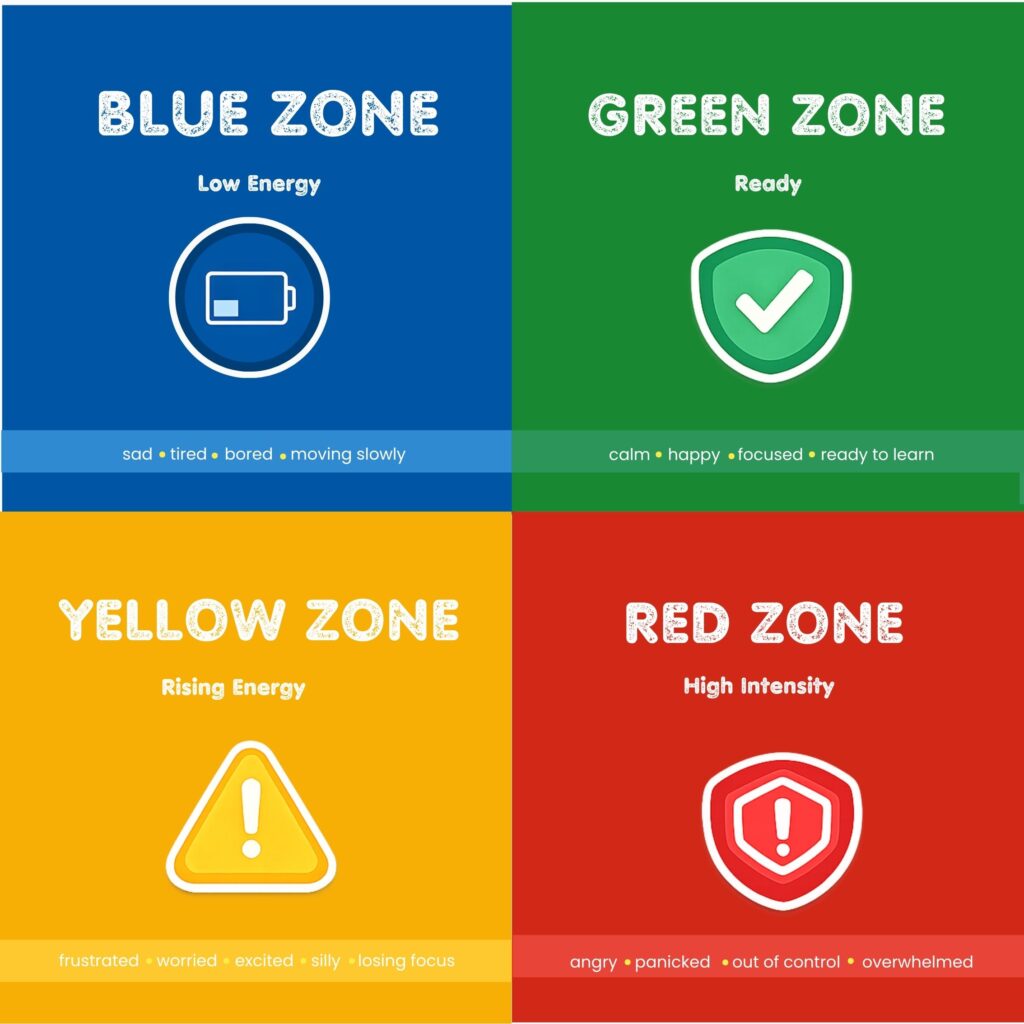
A helpful tool: The Regulation Zones
A simple and very effective way to introduce self-regulation is through the Regulation Zones.
This approach helps children understand how they feel by using four colors. It gives them a simple language to describe their internal state.
🔵 Blue Zone — Low Energy
The child may feel tired, sad, or disconnected.
In P.E., this might look like low effort, slow movement, or little participation.
🟢 Green Zone — Ready
The child is calm, focused, and ready to participate.
This is the ideal state for learning, cooperation, and engagement.
🟡 Yellow Zone — Rising Energy
The child may feel frustrated, anxious, excited, or unsettled.
This is often the moment when problems begin — rushing, arguing, or losing focus.
🔴 Red Zone — High Intensity
The child feels overwhelmed or out of control.
At this point, it is very difficult to think clearly, listen, or cooperate.
Important to remember
No zone is bad.
All feelings are normal and allowed.
The goal is not to keep children always in the Green Zone.
The goal is to help them recognize how they feel and use a tool to move forward in a safe way.
A practical self-regulation toolbox
Children need simple, clear tools they can use in the moment.
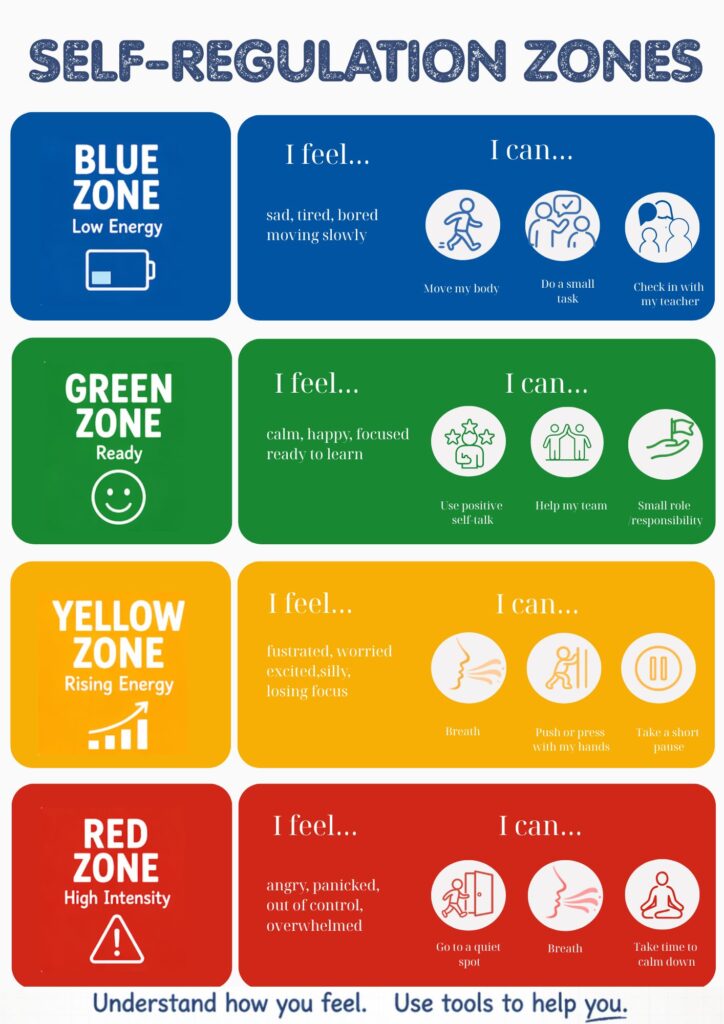
🔵 Blue Zone — “I need energy”
When a child seems tired or disengaged, the goal is to gently activate the body.
- Quick movement (jumping jacks, jogging)
- A small task or responsibility
- A short check-in with the teacher
🟢 Green Zone — “I’m ready.”
Here, the child is in a good state for learning. The goal is to maintain that balance.
- Positive self-talk
- A simple role in the activity
🟡 Yellow Zone — “I need to slow down.”
Here, the intensity is rising. Early support can prevent escalation.
- Breathing (inhale–hold–exhale–hold)
- Pressing hands together or pushing a wall
- A short pause before continuing
🔴 Red Zone — “First calm, then talk.”
When a child is overwhelmed, safety comes first.
- Move to a quieter space (not as punishment, but as support)
- Use fewer words and a calm tone
- Give time for the body to settle before discussing
What should the teacher do?
When a child is emotionally overwhelmed, they don’t need correction first.
They need calm and connection.
Helpful phrases:
- “I can see you’re upset.”
- “Let’s take a moment.”
- “Do you need a breath or a little space?”
- “What will help you continue?”
This approach shifts the focus from control to support.
The intro activity: “Run to the Color.”
Place four colored cones in the space.
Describe a situation and ask students to run to the color they think matches how they would feel.
For example:
- “You missed an easy point and feel frustrated.”
- “You are calm and waiting for your turn.”
- “You feel very tired and don’t want to join yet.”
Then ask:
- What are you feeling?
- Where do you feel it in your body?
- What could help you right now?
The goal is not the “correct” answer.
The goal is awareness and discussion.
Final thoughts
The gym is one of the few places where emotions move as fast as children do.
That is exactly why it can teach something much bigger than movement skills.
When we teach self-regulation, we are not only helping the lesson run more smoothly. We are giving students a skill they can carry beyond the court lines, into the classroom, into friendships, into everyday life.
Do not feel discouraged if some children find it difficult. Self-regulation takes time, repetition, and patience. It needs adults who stay calm, steady, and available.
The greatest victory is not always the one written on the scoreboard.
Sometimes, it shows in the moment a child pauses, takes a breath, finds their balance again, and chooses a better way to continue.
Join Our P.E. Community
Become part of a growing network of teachers who believe that movement is a powerful tool for learning. By joining our community, you’ll receive updates on new blog posts, free resources, and exclusive content — all designed to make your teaching more fun, inclusive, and effective.
Our Newsletter
Want fresh ideas, posters, games, and free P.E. resources delivered to your inbox?
Subscribe to our newsletter and be the first to know about new posts, exclusive content, and creative teaching ideas!
Because physical education should feel like play!